Qualcomm’s Irwin M. Jacobs: Technologies that changed our lives

If you find yourself increasingly dependent on your smart phone, Dr. Irwin M. Jacobs should be at the top of your list of people to thank. Jacobs, founding chairman and CEO Emeritus of Qualcomm Incorporated, was named the W. P. Carey School Dean’s Council of 100 Executive of the Year on April 19, 2012. Among his 14 patents are technologies that make your smart phone so indispensible.

QR codes: It’s all about the destination

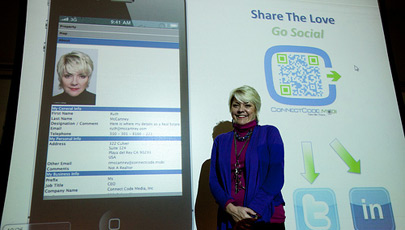
QR codes — those intricate square graphics — are showing up on signs, posters, print ads, business cards. They’ve even been painted on sides of buildings. When scanned by your smart phone, QR codes are supposed to take you to something more – more information, music, video. But not every QR code yields a good experience. Expert Ruth McCartney was in town recently to speak at MSIM classes and meet with local professionals to share what she’s learned about using this technology well.

Promises, promises: When one firm breaks them, two could suffer

A psychological contract  is an individual’s beliefs about the informal obligations that exist between employer and employee. What happens when an employer fails to come through on these perceived promises? Research shows that organizational citizenship behavior plummets, and when employees such as business analysts have two bosses, the downside of a broken promise multiplies, according to assistant professor of information systems Gregory Dawson.

On the same wavelength: The inner workings of successful teams

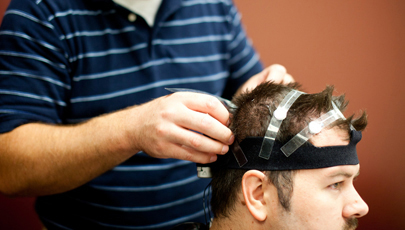
Just about every organization has teams that work together exceptionally well. You might say the members are on the same wavelength, but exactly what does that mean? An experiment conducted at the W. P. Carey School of Business by information systems professor Pierre Balthazard and management professor David Waldman may bring us closer to understanding what goes on when those teams are "in the zone." The researchers recorded the brainwaves of student teams using EEG technology.

Changing the way we talk about the cloud

"Cloud is cheap, fast and easy! Did we mention fast?!" "No hardware required!" "Why build what someone has already built?" Marketing pitches for cloud solutions sometimes run to hyperbole, creating a communications challenge for IT leaders. At a recent meeting of the Arizona Chapter of the Society for Information Management, Meritage Homes CIO Chris Filandro said that IT leaders have to do a better job of explaining to senior management the reality of the cloud.

Podcast: Grand challenges call for a new polymath

"Polymath" is the Greek word for Renaissance man — one who excels at many things. But if, centuries ago, society needed a Da Vinci or a Franklin, the grand challenges of today call for teams of experts. Author Vinnie Mirchandani in his book by the same name describes "The New Polymath" as an organization that gathers together diverse teams of specialists and multiple strands of technology to resolve not only our daily needs — for a smart car for example — but also meet the "Grand Challenges" that face us — like assuring an ample supply of clean water. He urges that companies as well as individuals begin to think in terms of "And not OR." But why should enterprises expand their aspirations? Mirchandani shows that by embracing the truly big picture, these enterprises are able to identify market opportunities as they are emerging. Mirchandani was the guest of the CABIT research center at the W. P. Carey School of Business recently. Center Director and Information Systems Professor Julie Smith David talked with Mirchandani after his presentation.