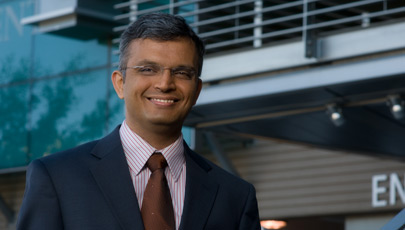
New faculty are experts on cyber security, privacy

Two new faculty members joining the W. P. Carey Department of Information Systems this fall will bring expertise in critical areas of information systems that have been making headlines. Roberto J. Mejias and Altaf Ahmad are the latest additions to a team of researchers probing the issues and attitudes surrounding cyber security and cyber privacy.

Changing the way we talk about the cloud

"Cloud is cheap, fast and easy! Did we mention fast?!" "No hardware required!" "Why build what someone has already built?" Marketing pitches for cloud solutions sometimes run to hyperbole, creating a communications challenge for IT leaders. At a recent meeting of the Arizona Chapter of the Society for Information Management, Meritage Homes CIO Chris Filandro said that IT leaders have to do a better job of explaining to senior management the reality of the cloud.

Through an IT lens: Professor Raghu Santanam

The mile markers in an academic career include the first post — as assistant professor — when scholars prove their research and teaching mettle. If successful, they are awarded tenure and the accompanying "associate professor" title. The top rung — called "full" professor — is reserved for a relatively small number, who are exceptional at teaching, have generously served their institution and discipline, and have provided leadership in the development of new knowledge. This spring, Raghu Santanam reached that peak.

Use prediction markets to raise your marketing model’s performance

Which prospects are most likely to buy what you’re selling? Who are your good credit risks? What will your customers buy next? Chances are, your company uses predictive models to answer these and other questions, or soon will. A recent study found that 38 percent of companies were using advanced analytics to create predictive models that can forecast consumer behavior, evaluate consumer credit-worthiness, pinpoint marketing targets and more, while 85 percent said they planned to start using such models by 2012. But sooner or later, most of these companies will experience model decay, in which performance lags and it’s time to pick a new model. How can managers judge which new "challenger" model will outperform or, at least, replace the reigning "champion?" Information Systems professors Michael Goul and Sule Balkan think one smart bet would be to try a market approach. Recent research conducted by these scholars found that "prediction markets" proved to be an effective approach to selection of predictive models.

Podcast: Grand challenges call for a new polymath

"Polymath" is the Greek word for Renaissance man — one who excels at many things. But if, centuries ago, society needed a Da Vinci or a Franklin, the grand challenges of today call for teams of experts. Author Vinnie Mirchandani in his book by the same name describes "The New Polymath" as an organization that gathers together diverse teams of specialists and multiple strands of technology to resolve not only our daily needs — for a smart car for example — but also meet the "Grand Challenges" that face us — like assuring an ample supply of clean water. He urges that companies as well as individuals begin to think in terms of "And not OR." But why should enterprises expand their aspirations? Mirchandani shows that by embracing the truly big picture, these enterprises are able to identify market opportunities as they are emerging. Mirchandani was the guest of the CABIT research center at the W. P. Carey School of Business recently. Center Director and Information Systems Professor Julie Smith David talked with Mirchandani after his presentation.

Stock market play could raise your marketing model’s performance

Which prospects are most likely to buy what you’re selling? Who are your good credit risks? What will your customers buy next? Chances are, your company uses predictive models to answer these and other questions, or soon will. A recent study found that 38 percent of companies were using advanced analytics to create predictive models that can forecast consumer behavior, evaluate consumer credit-worthiness, pinpoint marketing targets and more, while 85 percent said they planned to start using such models by 2012. But sooner or later, most of these companies will experience model decay, in which performance lags and it’s time to pick a new model. How can managers judge which new "challenger" model will outperform or, at least, replace the reigning "champion?" Information Systems professors Michael Goul and Sule Balkan think one smart bet would be to try a market approach. Recent research conducted by these scholars found that "prediction markets" proved to be an effective approach to selection of predictive models.