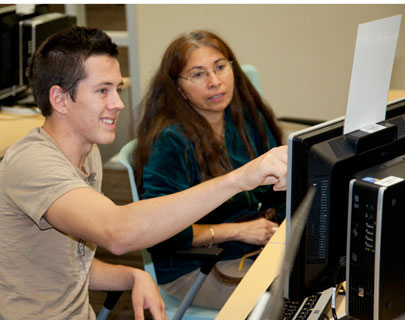
Giving back at the Tempe Public Library: DISC members teach computing classes

Twice a week during the fall and spring semester, members of the Department of Information Systems’ DISC club teach basic computing classes at the Tempe Public Library. The classes are free and open to the public, and the students who teach make a real impact in the lives of library patrons who need computer skills to build a business, land a job or communicate better over the Web. knowIT listened in as Shannon Keelan, Garrett Williams (pictured) and other students showed Luz de Maria Melendez how to make her way around the Internet.


Avnet’s Steve Phillips: IT is an ‘enabler for growth’

Phoenix-based Avnet, Inc. is one of the largest distributors of electronics components, computer products and embedded technology, a company whose roots go back to 1921. But technology is more than a product at Avnet. The company used technology strategically to transform aspects of his company as it secured its leadership position. Steve Phillips, Avnet’s senior vice president and chief information officer, spoke at the Leadership Seminar Series, a program that brings industry leaders and experts in contact with the professionals enrolled in the evening Master of Science in Information Technology (MSIM) program.

SaaS: New efficiencies for businesses; new role for the IT pro

Software as a Service is reshaping corporate computing and eventually will become the means by which many small and medium-sized companies acquire and use most of their applications, say Information Systems Professors Julie Smith David and Michael Lee. And in time, it is likely that even bigger firms will get much of their software via online subscriptions. Many of the objections to SaaS are larger than life, the researchers say. But for IT professionals, these services will mean relinquishing their traditional role as software gatekeepers and assuming a new role as facilitators and enablers.

Boot camp for IT managers: The MSIM Applied Project

Many business school-based IT programs are balanced heavily toward technology, but not the Master of Science in Information Management (MSIM) at the W. P. Carey School. Grounded first in business, the program prepares managers to analyze business issues, then leverage technology deftly to create value for their firms. It’s not tech for tech’s sake, but rather tech for the benefit of the company. For students, it all comes together in the applied project course, during which they practice what the program is teaching them to do in their careers: uncover the challenges, figure out a solution, then determine how technology can play a role in achieving long term, strategic competitive advantage.

The IT thread: New business students learn about IT ubiquity

Information Systems Lecturer Matthew McCarthy says "there’s no business that doesn’t have IT coursing through it." That’s why in the W. P. Carey School, all incoming students — no matter what major they have chosen — are required to take CIS 105. As a result, about 4,000 students a year populate McCarthy’s lectures. knowIT sat down with him recently to talk about what the course covers, how to succeed in the class, and the special way the Department of Information Systems gives students a peek into the future.

Bridging the gap: How internal audit and IT can work together to improve information security

In many organizations, the internal audit and information security functions can’t seem to get on the same communication wavelength. For companies interested in improving their information security infrastructure, however, this is a disconnect that must be fixed, according to information systems Professor Paul Steinbart. In a keynote address at a recent International Conference on Accounting and Information Technology meeting, Steinbart told his audience that preventative information security is almost always more effective than corrective or detective information security. And, he says, internal audit can play a hugely valuable role in the creation of an effective preventative IT strategy.