New attitudes, technology paint a brighter future for videoconferencing

Videoconferencing has been touted as a practical, here-today technology that can save companies from having to fly employees all over. But despite its practicality, adoption of this technology has been minimal. Advances in audio and visual technology, and a sea change in attitudes about communication may change all that. Harvey Shrednick and Ajay Vinze, both information systems professors at the W. P. Carey School of Business, believe that after years of unfulfilled hype the time may finally be right for videoconferencing.


A quiet but growing revolution: The disruptive technology of on-demand software aggregators

Google, a bellwether of online computing, recently announced OpenSocial — its next generation answer to Facebook, which had previously opened up its platform. But platforms that allow outside developers to create bolt-on applications are not just for the novelty functions found on social networking sites. The same concepts are being used by software companies like Salesforce.com to add value and functionality to their online platforms. As a result, in the view of Julie Smith David, Director of the Center for Advancing Business through IT at the W. P. Carey School of Business, the whole software industry is — or soon may be — all shook up.

The best tool for the job: Selecting and implementing e-tools

Tools to facilitate the full range of business processes proliferated over the past decade. Some firms base entire business models or product lines on such tools, while other traditional companies are looking for tools as a means to improve operational efficiency or processes. "The question facing supply management professionals today might be best summarized as: How do we ensure we’re getting the most out of the e-tools available?" according to a report from CAPS Research, a strategic sourcing research center co-sponsored by the W. P. Carey School of Business.

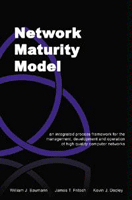
The road to a mature network

Computer network problems cost American businesses $100 billion each year. While the underlying issues may be technologically complex, anyone who has ever fumed about a company-wide e-mail outage or an overloaded web site has an idea of the costs, says Kevin Dooley, a professor of supply chain management at the W. P. Carey School of Business. Dooley and his co-authors have just published "Network Maturity Model: An integrated process framework for the management, development and operation of high quality computer networks." The book outlines a descriptive framework that helps businesses assess the soundness of their networks and improve the veins that carry the lifeblood of companies in the information age.

IT evolution, Part 2: Could REA analysis topple ERP systems?

Enterprise resource planning (ERP) systems have a growing reputation for being big, slow, pricey and just about impossible to change once they’re installed. Those aren’t exactly promising survival traits in competitive environs that demand IT agility. In the conclusion of our two-part story, Julie Smith David, associate professor of information systems at the W. P. Carey School of Business, discusses REA (resources, events and agents) analysis, a method of system modeling that may meet the information and agility requirements of corporate computing today.

IT evolution: Why ERP systems face extinction

With any luck at all, there isn’t a giant asteroid headed our way soon, but in the world of information technology, an extinction event may be on the horizon. Enterprise resource planning (ERP) systems — those monolithic software packages that evolved to tame companywide data — may be heading the way of trilobites and dinosaurs. Once in place, ERP systems are rigid, says Julie Smith David, an associate professor of information systems at the W. P. Carey School of Business — not the adaptive trait that leads to success in a dynamic environment.